The Lost Habit of Careful Reading: Why Skimming Creates Confusion
By Zlatoslava Karga, DNP, PMHNP-BC
One of the patterns I have noticed both in clinical practice and everyday life is how often people skim information instead of truly reading it. This may seem like a small issue, but its effects can be surprisingly significant. Misunderstandings, anxiety, and frustration often begin not because information is missing—but because it was not fully processed.
A simple real-life example illustrates this well.
A seller listed a small porcelain trinket box online. The description clearly stated that the lid had been glued back together, and multiple photos showed the repaired area. The seller was transparent and honest about the condition. Despite this, the seller received many enthusiastic messages from potential buyers asking if they could purchase the item immediately.
However, when the seller reminded them that the lid had been glued and asked whether they had seen the photos and description, many responded the same way:
“Oh, I didn’t notice that. I changed my mind.”
Even after the seller added a new photo highlighting the repair with a visible mark and repeated the warning in the description, the same pattern continued. People expressed excitement first, but only later realized they had missed critical details.
This situation may sound humorous, but it reflects a larger issue in modern life: many people scan information quickly instead of reading it carefully.
Reading is not simply looking at words. True reading involves attention, interpretation, and reflection. It requires the brain to process meaning, not just recognize letters. When we skim, we often pick up only fragments of information and fill in the rest with assumptions. This can lead to confusion, incorrect conclusions, and emotional reactions based on incomplete understanding.
Why does this happen so often today?
One reason is cognitive overload. We live in a fast-paced world filled with notifications, messages, advertisements, and endless streams of digital content. The brain adapts by trying to move quickly through information rather than carefully analyzing it. Skimming becomes a survival strategy in an environment that constantly demands attention.
Another reason is impatience. Many digital platforms encourage quick responses and fast decisions. People scroll rapidly, searching for highlights rather than details. Over time, this changes reading habits. The brain becomes accustomed to scanning rather than deeply engaging with written material.
There is also the role of emotional urgency. When someone feels excited, interested, or anxious, they may react before fully understanding what they are reading. In the example of the trinket box, excitement about purchasing the item likely replaced careful observation of its condition.
While this may seem like a small inconvenience in daily life, the consequences can be much more serious in healthcare settings. As a psychiatric nurse practitioner, I frequently see misunderstandings that arise from incomplete reading. Instructions are provided, but not fully reviewed. Recommendations are written, but partially interpreted. Questions are asked that have already been answered in the provided materials.
This does not mean people are unintelligent. Rather, it reflects a growing habit of rushing through information instead of engaging with it thoughtfully.
Careful reading is a cognitive skill, and like any skill, it requires practice. It involves slowing down, paying attention to details, and verifying understanding before reacting. Sometimes, it means reading the same paragraph twice. Sometimes, it means pausing before responding.
Mindful reading is closely connected to mental wellness. When we misunderstand information, uncertainty increases. Uncertainty often leads to worry, frustration, or unnecessary stress. By contrast, clear comprehension promotes confidence and reduces emotional reactivity.
In many ways, careful reading is a form of mindfulness. It requires focus, patience, and presence. It asks us to pause long enough to truly understand what is in front of us.
Perhaps the most important question we can ask ourselves before reacting to written information is simple:
Did I truly read this—or did I only skim it?
That small moment of reflection may prevent confusion, reduce anxiety, and improve decision-making in ways that reach far beyond a simple online purchase.
From Rug to Understanding: A Reflection on Learning, Error, and Confidence
Three years ago, when I purchased this rug, I was at the very beginning of my journey into collecting hand-knotted textiles. Like many people entering a new field, I was driven by fascination rather than knowledge. The colors, the patterns, the sense of history—these drew me in. But I did not yet have the skills to truly understand what I was looking at.At the time of purchase, I was told this was an antique Turkish rug. I accepted that description. Not because I verified it, but because I did not yet know how.
Today, I can say with confidence that this rug is neither antique nor Turkish. It is a vintage Persian rug, most likely from the Hamadan region, produced around the mid-20th century. This conclusion did not come from a single source or moment of realization. It came from time, repetition, and exposure.
Understanding rugs—like understanding anything of substance—requires more than surface observation. It requires handling, turning the piece over, studying the back, recognizing structure. It requires seeing many examples, comparing them, reading, asking questions, and sometimes being wrong. The back of this rug, for example, reveals the knotting structure. Turkish rugs use a symmetrical knot; Persian rugs use an asymmetrical knot. This is not obscure knowledge—it is foundational. And yet, without experience, it is easy to miss.
Another layer of learning came through attention to detail. This rug has been repaired multiple times. One section was replaced later using synthetic dyes, now visibly faded compared to the rest of the piece. These details tell a story—not just about the rug, but about the importance of careful observation. What once looked like a unified object now reveals itself as a composite of time, wear, and intervention. Looking back, the most important realization is not that I misidentified the rug. It is that I relied entirely on someone else’s authority at a time when I lacked my own.
This is how most of us begin—in any area of life. We are apprentices. We depend on others to interpret reality for us. And that dependence can create anxiety. We sense that we do not fully understand, but we do not yet know how to bridge that gap. The process of learning changes that.
As knowledge builds—through study, repetition, and direct experience—something shifts. The world becomes more legible. Conversations become clearer. Claims can be evaluated rather than accepted. The anxiety that comes from uncertainty begins to diminish. This applies far beyond rugs.
Whether you are speaking with an insurance representative, negotiating with a car dealer, or seeking a repair for something you do not fully understand, knowledge alters the interaction. You begin to recognize patterns. You understand the language being used. You can ask better questions. You are less likely to be misled—not because others intend harm, but because you are no longer entirely dependent on their interpretation. The rug, in this sense, is not just an object. It is a record of a stage in learning.
It reflects the moment when curiosity existed without structure, when trust replaced verification, and when experience had not yet accumulated. But it also represents progress. The same object, viewed years later, reveals how much has changed—not in the rug, but in the observer.
We often underestimate the value of these early mistakes. Yet they are essential. They are not failures of judgment; they are necessary steps in developing it. Expertise is not something we are given. It is something we build—piece by piece, detail by detail—until what once felt uncertain becomes familiar, and what once caused hesitation becomes manageable. And sometimes, all it takes to see that clearly… is turning something over and looking at the back.


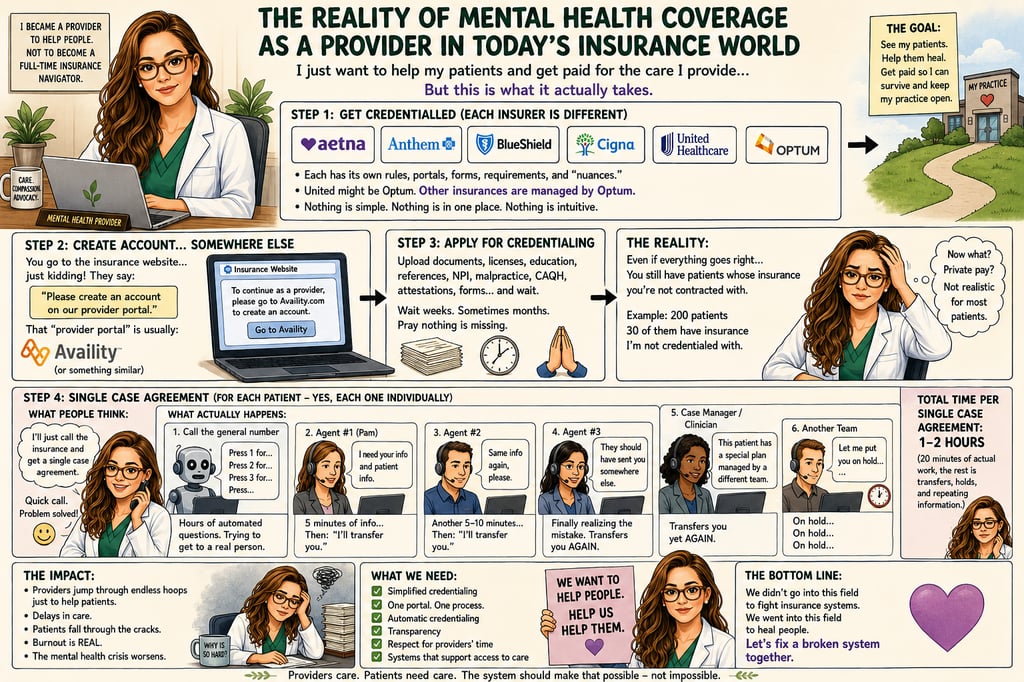
My Noble Quest to Obtain Access to Care for My Patient
I have a patient who needs access to care because they changed insurance, and I am not in network with their small obscure insurance plan. So I decided one of the easiest solutions would be to create a single case agreement.
I called the provider number on the back of the insurance card, and after struggling with AI prompts and repeating myself multiple times, I finally reached a live agent.
The agent then gave me a different number to call.
So I called the different number. Again, I struggled through AI verifications, repeating the same information over and over again to the point where I had memorized it by heart.
Eventually, I reached another live agent.
Who also told me:
“Oh, no, you actually need to call a different number.”
So I called the third number.
After once again fighting my way through the AI system just to reach a live person, that agent finally informed me:
“Oh no, this is actually handled by the previous department. The lady who transferred you here handles that.”
At this point, I explained:
“Look, I have already spent about 30 minutes trying to get to somebody because my patient needs care.”
The agent paused and then said:
“Oh, okay. Let me see if I can direct you to somebody who actually knows where you need to call.”
So I stayed on hold for another 20 minutes waiting to be transferred.
Finally, the agent returned and apologized.
“Oh, I’m so sorry. It’s getting closer to the weekend and late afternoon, so that agent is already gone. But I’ll pass along your information.”
At that point, I paused for a moment and then replied:
“You know what, I changed my mind. Can you please forward me to HR for a job application? I’d like to clock out on Thursday for the weekend myself.”
Seeing the Unseen: What a Forgotten Portrait Taught Me About Beauty, Grief, and Hope
Zlatoslava Karga, PMH NP, DNP
As a psychiatric nurse practitioner, I spend much of my professional life helping people explore what lies beneath the surface. Symptoms tell a story, but rarely the whole story. Human beings are infinitely more complex than the first impression they make.
Perhaps that is one reason I have become such an avid art collector.
Among my favorite pieces to collect are Victorian family portraits. There is something profoundly moving about preserving the faces of people who would otherwise be forgotten by history. Their names may be lost. Their stories may be gone. Yet their humanity remains.
Recently, while browsing a local thrift store, I came across an extraordinary portrait of a woman. The painting was unremarkable to some observers. In fact, when I brought it home, several members of my family immediately responded with the same judgment:
“What an ugly woman.”
I disagreed.
The longer I sat with the portrait, the more beautiful she became.
Not because she fit a modern standard of beauty. Not because she had perfect features. Rather, because her face revealed something deeper. Her eyes held a story.
When I look at this woman, I am looking into the face of someone who has been dead for many years. I do not know her name. I do not know who painted her. I do not know where she lived, whom she loved, or what hardships she endured.
And yet, somehow, I feel I know something about her.
I see hope.
I see love.
I see resilience.
I see someone who survived grief.
There is a quiet sadness in her expression, but it is not despair. It is the sadness of a person who has suffered loss and continued forward. Her eyes suggest someone who buried loved ones, endured disappointments, and experienced the inevitable sorrows of life. Yet they also reveal tenderness and expectation. There is still a future in those eyes. There is still warmth.
That is the remarkable power of art.
A great work of art does not simply show us what a person looked like. It reveals something about who they were.
This is why I believe it is important to visit museums and galleries. It is important to sit in front of a single work of art and allow yourself to truly absorb it. Not to rush from painting to painting, taking photographs along the way, but to slow down and listen.
Every meaningful artwork contains layers of communication. Some messages are obvious. Others are hidden. They emerge only when we spend time with the piece and allow it to speak.
In our modern world, we are surrounded by images. Thousands of photographs pass before our eyes each week. Many of them are selfies, carefully curated snapshots intended to present a particular version of ourselves. They may communicate something genuine, but often they remain on the surface.
I am not speaking about the art of photography itself. Photography can be profound and deeply moving. Rather, I am reflecting on our culture’s tendency to consume images quickly, without contemplation.
Art asks something different of us.
Art asks us to pause.
To observe.
To wonder.
To see beyond appearances.
The portrait in my thrift store find reminds me that beauty is not always found in symmetry, youth, or perfection. Sometimes beauty resides in endurance. Sometimes it lives in the quiet dignity of a face that has known suffering and still chooses hope.
As a mental health provider, I am reminded daily that every person carries an unseen story. We often judge ourselves and others based on what is immediately visible. Yet beneath every face is a lifetime of victories, heartbreaks, sacrifices, and dreams.
Perhaps that is why this unknown woman’s portrait speaks to me so strongly.
She is gone. Her name may never be known again.
But her eyes continue to tell a story.
More than a century later, they still speak of love, loss, courage, and hope.
And if we are willing to look closely enough, they remind us that the most important things about a person are often the things that cannot be seen at first glance.


The Art of Sharpening the Mind
Zlatoslava Karga, PMH NP, DNP
A dull knife will not cut a tomato.
A dirty mirror will not show your image.
These simple observations contain an important truth: tools must be maintained if we expect them to perform well. Yet many of us forget that our minds are also tools. Like a knife, the mind must be sharpened. Like a mirror, it must be cleared and polished. Mental fitness does not appear automatically; it is developed through use.
Most people understand physical fitness. We know that no one wakes up one morning and runs a marathon without preparation. If you have not exercised for months, even a short jog may leave you breathless. Muscles strengthen through repetition. Endurance grows through practice. We accept soreness as part of the process.
Yet when it comes to our minds, we often expect a different outcome.
I frequently hear patients say, “I can’t sit through a lecture,” “I can’t focus on a textbook,” or “I can’t pay attention long enough to learn something new.” Sometimes the immediate assumption is that something must be wrong—ADHD, anxiety, lack of motivation, or the need for a medication adjustment.
Those factors can certainly play a role. However, before exploring diagnoses or treatments, I often ask a different question:
What is your mental fitness like?
The question usually catches people by surprise.
How often do we ask our minds to do difficult things?
How many books have we read cover to cover that were not highly entertaining? How often do we sit with a challenging subject simply because it stretches our thinking? How frequently do we listen to a long presentation and intentionally work to understand it rather than reaching for our phones at the first moment of boredom?
Attention is a skill. Concentration is a skill. Learning is a skill.
And like any skill, they improve with practice.
We live in a world designed to entertain us. Videos become shorter. Notifications compete for our attention. Information is delivered in quick, easily digestible pieces. While convenient, this environment often trains us to seek constant stimulation rather than sustained focus.
Mental endurance begins to weaken when it is not exercised.
Memory follows the same principle.
Not long ago, many of us memorized dozens of phone numbers. We remembered directions, appointments, birthdays, and addresses because we had to. Today, our devices remember those things for us. While technology is useful, it has also reduced some of the daily exercise our memories once received.
Memory expands when challenged and contracts when neglected.
The encouraging news is that mental fitness can be strengthened at any age.
Choose a lecture or documentary on a subject that does not immediately interest you. Watch it carefully. At the end, ask yourself, What did I just learn?
Read a book that challenges you rather than one that merely entertains you. Work through difficult material instead of abandoning it at the first sign of boredom.
Practice staying present when your mind wants to wander.
These small exercises gradually train the brain to tolerate complexity, absorb new information, and sustain attention for longer periods of time.
The goal is not to eliminate boredom. The goal is to develop the ability to remain engaged despite it.
Just as physical fitness prepares us to climb mountains, run races, and carry heavy loads, mental fitness prepares us to learn, adapt, solve problems, and navigate life’s challenges.
A sharp knife cuts cleanly.
A polished mirror reflects clearly.
And a trained mind is capable of far more than we often realize. The question is not whether your mind is capable. The question is whether you are giving it the exercise it needs to grow stronger.
When Bureaucracy Stands Between Patients and Care
By Zlatoslava Karga, PMHNP, DNP
One of the greatest weaknesses of the current U.S. healthcare system is not a lack of skilled providers or a lack of patients seeking help. It is the complexity created by having multiple insurers, each with its own rules, contracts, and credentialing requirements.
When a provider opens an independent practice, caring for patients is only part of the job. To accept insurance, the provider must become credentialed separately with each insurance company. Every insurer has different applications, different requirements, different timelines, and different restrictions. Months can be spent completing paperwork instead of providing care.
This directly affects patients.
Medicare is perhaps the clearest example. Most Americans contribute to Medicare throughout their working lives. At age 65, many enroll in Medicare Part B because they have earned that benefit through years of contributions.
What many patients do not realize is that once Medicare becomes their primary insurance, their provider must also be enrolled and approved by Medicare in order to continue treating them. The enrollment process can take months, creating interruptions in care that neither the patient nor the provider anticipated.
Even more surprising is that Medicare patients often cannot simply choose to pay privately while a provider is waiting for enrollment approval. Many patients assume they can pay cash and continue treatment with the clinician they trust. In reality, Medicare rules are far more restrictive.
There are circumstances in which Medicare beneficiaries may pay privately, but those situations generally require the provider to formally opt out of Medicare and comply with additional federal requirements. This creates another layer of paperwork, reporting obligations, and administrative oversight for providers who choose that path.
As a result, both patients and providers can find themselves trapped in a system where the desire to continue care exists on both sides, yet administrative rules make that continuity difficult or impossible.
From an administrative perspective, patients can simply be directed to another provider.
From a mental health perspective, it is not always that simple.
Mental health treatment depends on trust, continuity, and therapeutic relationships built over time. Patients struggling with depression, anxiety, trauma, cognitive difficulties, or other psychiatric conditions are often vulnerable. Changing providers is not merely changing a name on an insurance directory. It means retelling painful histories, rebuilding trust, and starting over during a time when stability may already be fragile.
A simpler system is possible.
Universal coverage for basic medical and mental health services would allow patients to focus on receiving care rather than navigating insurance networks. Providers could focus on treating patients rather than spending months completing separate credentialing processes for multiple insurers.
Healthcare should prioritize access to care and continuity of care. When a patient needs help and a qualified provider is available to provide it, administrative barriers should not stand between them.
The purpose of healthcare is care. Our systems should reflect that principle.

